Day 9 Magdala and Metula

The plan today was to head north to Metula, the settlement closest to the Lebanese border in the region, and to see if we could look back to where we had been two months before in Lebanon.

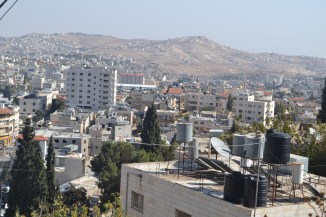
We drove north through Tiberias, managing, as always to get completely lost. You drive into the centre of the town and all the road signs cease. No numbers, no indication of where to go. We ended up on a housing estate on a hillside above the road we wanted. Nice view though!

Eventually we found the main road 90 again and continued along the lake shore. I needed petrol so we pulled in to a filling station and spotted a sign to Magdala. Again thus was not straight forward and we visited a building site, before eventually finding the archaeological site nearby. It was comparatively cheap – a mere 15 shekels and I got a 5 shekel discount for being an old fart- hurrah!

I have written a monologue spoken by Mary Magdalene in which she repudiates any association with the town. However I may have to change that having visited the place. If clearly was quite a thriving port and centre of the fishing industry. They have uncovered a 1st century synagogue in which it is quite likely Jesus may have preached. It is beautiful in its simplicity with mosaics on the floor and painted plaster walls.

The rest of the discoveries are of shops and some quite sizeable houses along with some purification baths with seven steps leading down into them. Josephus records some 30,000 to 40,000 living there, but he always exaggerated. Archaeologists believe 3,000 to 4,000 is nearer the mark, but that still was a sizeable population in those days. Its core occupation was fishing and the preserving if fish, some of which may have been sent to Rome. It was on one of the great trading routes up the Rift Valley and of course the regional capital, Tiberias was only 6 or so miles away.

We found the place entrancing. A guide had approached us earlier, but we had declined her services, preferring to view the site on our own. However she came up to us later and gave us some more background which was interesting. She was Irish and voluble, her words spilling out of her in a torrent of brogue. The whole dig is privately funded with much of the money coming from wealthy Catholics.

There must be quite a bit if money as they have built a beautiful ‘church’ / religious centre near by. Inside the building there is a beautiful atrium with pillars celebrating    Christian women. Four side chapels lead off it, each with an interesting mosaic depicting a scene from the gospels. Glas doors separate it from the main church which us stunning. The altar is a wooden boat set in a green marble floor. Beyond is a window looking over an infinity pool and the Sea of Galilee beyond. If us breath-taking, yet simple.

We met the priest in charge there, a delightful man who wants to see this as an ecumenical centre, not just a Catholic one. He also hoped that it would be a centre where Jews and Christians could meet and exchange ideas. Down in the basement us another chapel, dominated by a wonderful reredos of  feet in sandals. It is called ‘The Encounter’ and shows a hand reaching between the feet to touch the hem of Jesus’s robe. I loved it.

image

From Magdala, we drove north to Metula on the Lebanese border. Once there we got a bit lost again and ended up in a housing estate with stunning views over Lebanon. There , on the horizon was Beaufort, the crusader castle where we had been standing a couple of months ago! Mission accomplished!

On the other side of the valley was the snow capped peak of Mt. Hermon. The views were wonderful and we went up to Dado’s lookout where there was an audio commentary in English, giving the Israeli side if the war with Lebanon.Very interesting!

Then we visited a local National Park with a spectacular waterfall before heading home.

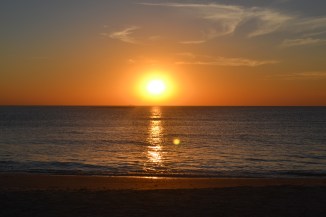
As we drove back down into the Galilee valley the hills to the east were lit up by the setting sun!

image


Day 8 – Nazareth and Zippori


Rain today and definitely cooler. We aimed for Nazareth on the basis we would probably be in doors for much of the time. Quite a good choice as it turned out.

On the advice of the receptionist at the Jerusalem Hotel we had downloaded a free satnav for my mobile phone. We call her Rachel, and she has proved to be one of the most unreliable navigators in the history of mankind. She may of course be wreaking revenge for the British Mandate and all that then ensued, or she may just be very incompetent, but either way we shall not be using her in future.

We set off for Nazareth, and proceeded by a somewhat devious route, but got there eventually by reading road signs and ignoring Rachel. We headed into the old city and amazingly found a small car park just below the Church of the Annunciation. For a mere 20 shekels we could stay all day!

image

We walked up the street and circumnavigated the building, eventually asking a very pleasant local how to gain access. The church is massive and very modern (1969). It is built on the foundations of a Byzantine church which apparently lies on the house where Mary got the call from Gabriel. We started by wandering around the outside looking at various representations of the virgin and child from around the world. It was fascinating to see the cultural differences.n

Then we went inside St Joseph’s church which is quite simple and rather attractive. Underneath it are some more remains, although it was unclear what they were – possibly his carpenter’s shop?

We had a little difficulty finding our way into the main church, but when we did, it was well worth it. It is very impressive, with a large dome and concrete pillars. More representations of Mary and Jesus from around the world are on the walls.

Down in the crypt is the Grotto of the Annunciation and we duly filed past it, while others had their pictures taken in front of it or prayed. The latter seeming to be the more appropriate activity to me.

From the church we walked up into the souk, much of it closed as it was out of season. Nevertheless it was charming and we plodded up through it to the White Mosque, one of the oldest religious buildings in the town, dating from the 1700s. We were made very welcome and admired it’s fine prayer hall.

Across from it was a small cafe where we enjoyed some Arabic coffees and I enjoyed an interesting baklava, not unreminiscent of an apple turnover to look at. Wandering further, Christine found a very nice scarf in a small shop. It claims to be real cashmere and cost only 20 shekels. Those two facts do not seem to tally, but it is a nice scarf so who cares!

We eventually found our way back to the car, after a few hesitations and asked Rachel to find a route to Zippari, a hilltop town from the Roman times. She got us completely lost, but when we reset her led us triumphantly to the place!

It was still raining on and off, was quite cool (jumpers and fleeces needed) and very windy. We parked and walked around the site. The mosaics are amazing and clearly there is still much more to be found. On the very top of the hill are the remains of a villa with a central dining/living room with an beautiful mosaic showing the life of Dionysus. The views from the top were stunning, particularly as the clouds parted and sent shafts of light over the hills. Unfortunately we only had about an hour and a bit to look around before the site closed.

We set Rachel the task of getting us home. She began well, but then sent us down a side street into a residential area, through a factory site and finally onto a gravel track on the side of a mountain. We switched her off and retraced our steps. Using the signs we found our way to Tiberius and thus home. Rachel has been fired.

image

Tonight we are going to try a different restaurant down in the village. Tomorrow, who knows! Perhaps a journey to the Lebanese border – just the two of us, Rachel will not be coming . Two’s company……….!

Day 7 Around the Sea of Galilee

We left at around 10.00 a.m. and drove east around the southern tip of the Sea of Galilee towards En Gev. We stopped at a small picnic place with access to the lake shore. It was beautiful. Two fishing boats were out on the lake, flocks of birds took off and landed, the reeds swayed in the light breeze and the water lapped the shoreline. It did seem almost biblical. We paddled and picked up shells.

Then we continued north towards Bethsaida, stopping next at the National Park which had a walking and water trail through the reeds and trees. We opted for the walking route as the water trail involved swimming in places. The peace and quiet was heavenly and we saw a variety of birds, butterflies and dragonflies, as well as a range of flora, including mimosa and eucalyptus.

A short distance on from there and we had rounded the head of the lake and crossed several tributaries which feed in from the north. Now we entered the River Jirdan Nationsl Park and the ruins of the old town of Bethsaida. This is one of the largest tels in Israel and is mentioned in the O.T. as Zer in the territory of Geshur. Bethsaida means ‘the house of the fisherman’. According to the N.T. Jesus performed some of his miracles here including the feeding of the multitude and the healing of the blind man. From the Bethsaida shore he was seen walking on the water. Peter, Andrew and Phillip were all from Bethsaida. Ultimately Jesus condemned the city, ‘Woe to you, Chorazin! Woe to you, Bethsaida!

image

The site is fascinating and as we walked up the road, leading to the massive gateway into the city, you couldn’t help but wonder if Christ had walked here 2,000 years ago. The site was deserted and very atmospheric. The gateway is impressive as are the fisherman’s house and the winemaker’s house.

The only thing to give one pause was the large sign that hung on the fence warning of land mines. This place was held by Syrian troops in the 1967 conflict and there is still evidence of trenches, tunnels and bomb shells.

Still the birds and the butterflies fluttered around, putting on a colourful display for us.

A short drive down a paved track brought us to The River Jordan Park, clearly a very popular destination in the season, but now deserted. Picnic tables, camp sites, children’s play grounds, signs for kayaks all testified to a fun place in the summer. Now it was quiet. We decided to try to walk down to the Jordan, so parked under some trees. On the path ahead of us 3 mammals with long tails vanished into the reeds. We approached quietly and rounding a bend were rewarded with a wonderful view of mongooses (we had to check this out with the warden as we left).

We walked down through tunnels of reeds and eventually found the River Jordan sparkling in the afternoon sunshine.

Back in the car we headed for Capernaum which had been our goal all day. We stopped first at the Capernaum Nationsl Park, which seemed remarkably deserted. This gave us stunning views over the lake and an encounter with a large herd(?) of rock hydrates which really are the most delightful creatures.

imageOn the waterfront there were herons and egrets. Cloud was building and the sun was shining through in rays. One half expected a large hand or finger to break through!

image

We walked to a beautiful Greek Orthodox Church where a group of Romanians had arrived to look around. We managed to sneak in ahead of them and then sit by the lake for a while. We wanted to find Simon- Peter’s house which is said to be here. Someone pointed us to a space ship like building a couple of fields away. No chance of walking to it thanks to high fences, so we drove. There must have been 20 coaches in the car park.

We parked and paid our 5 shekel entrance fee each and walked up into the space ship which hovers over the supposed house. It is run by the Franciscans who seem to have ruined what should be a charming set of foundations incorporated not a Byzantine church, also now ruined. The space ship is a circular church with a glass roof at its centre over Peter’s house. I suppose it is to stop people pinching bits of it, but it looks awful and removes any atmosphere. Better is the synagogue built on the foundations of the one that Jesus probably preached in, but again the sheer number of visitors does not help the atmosphere. But who am I to criticise, I am part of the problem!

image

Finally we drove up the Mount of the Beattitudes to a another church, quite simple inside and with stunning views over the Sea of Galilee. Night was falling fast so we decided to head back to Kinneret. When we stopped so that Chrsirine could take a picture of the hills a man with a French accent and halitosis asked for lift into Tiberius. We were happy to oblige, unaware at that point of his bad breath. Poor Mike sitting next to him suffered all the way down to the town!

Tomorrow rain is forecast so we shall make decisions about what we do once we know the weather situation. Nazareth beckons, but also repels, filled as it will be with pilgrims eager to look at ‘supposedly’ sites. Has to be done though, I suppose!


Day 6 – Looking over Jordan

…….and what did we see? Well Jordan of course, since it is the other side of the river! We rise late, had a very good, leisurely breakfast and then Christine and I set off south down the Jordan valley, while Dani and Mike opted to chill out in the local area.

Our first stop was a crusader castle – Belvoir, perched high above the Jordan Valley. It is spectacular! The valley is very fertile. A lot of the greenhouses are growing bananas. There are also large numbers of fish farms.

The views take your breath away, but the castle is also well preserved and the Israel Nature and Parks Authority have done their usual superb job in terms of a clear leaflet and information boards around the site. In 1168 the Hospitaller Knights bought the site from a French noble family named Velos and built a fortress there and occupied it over the next 21 years. Eventually it was besieged by Saladin for a Year and a half before the Knights eventually surrended.

A very impressive ruin is left with an inner and outer fortress and a deep moat on three sides. What was nice from our point of view was that there was hardly any one there and so we could wander around in peace and quiet. Only towards the very end did three coaches arrive and disgorge a large number of Israeli visitors. We fled, having enjoyed our visit immensely.

Our journey up and down the mountain was interesting as they were doing a lot of work on the road and so large lorries thundered past us or came hurtling down behind us. Bulldozers and levellers meandered across the single track road and in places the road was vertiginous.

Back on the road south we came to Beth Shean or Bet She’an National Park, one of the most amazing Roman / Byzantine sites we have ever seen. It is situated below a tel which boasts some 20 settlement strata, starting in the 5th millennium B.C. and continuing with an Egyptian settlement in the late Canaanite period (16th -12th centuries BC). The city was taken by King David and then became an administrative centre of the region under Solomon. Under the Romans it became on the cities of the Decapolis and the most important city in northern Israel. Under Roman rule the city expanded and prospered with magnificent public buildings going up including a 7,000 seater amphitheatre. Under the Byzantines it became largely Christian and had a population of between 30,000 and 40,000. It all came to an end when an earthquake in 749 A.D. devastated the city. It became little more than a village and was forgotten Now it is being excavated and what they are finding is truly amazing.

Again we had the place almost to ourselves, which was wonderful. I stood on the stage of the amphitheatre and tested the acoustics, then wandered around one of the bath houses.

We walked down the colonnaded main street, then climbed the tel for a spectacular view of the Jordan valley and the whole archaeological site. As we arrived back at the main entrance a group of Japenese or Chinese arrived, but by then we were on our way! They had missed their chance of standing in front of what we were trying to photograph!

On our way home we made a small deviation into a kibbutz, looking for the site on the Joradan where Jesus may have been baptised. We eventually found it some distance away. We would have guessed where it was by the 10 – 20 coaches parked in the area. The prospect of 200 of more Americans singing ‘As I came down to the river to pray’ proved too much and we went the wrong way around the car park, narrowly missing a coach, turned into another kibbutz by mistake and drive through  the middle of it hoping to find a way out, which we eventually did.

Tonight we will go to the first ever kibbutz ( Dganya Alef) for a meal in their restaurant. No plans as yet for tomorrow, but I suppose we should hit the pilgrim trail again. Perhaps a trip around the Sea of Galilee before it rains on Wednesday?

image

Day 5 – heading north

A mixed day in many respects. We left the hotel at about 9.30 in a taxi bound for Tel Aviv airport to pick up our hire car. At the airport I did discovered I had left my phone and our guide book in the taxi. By sheer luck, I had taken the driver’s card and phone number, so was able to phone him and ask him to come back with it. Expensive, but a relief!

Then we set off for Caeserea. The car is a Toyota Aventis and very nice to drive, as well as comfortable inside. We reached Caeserea at about 1.30 and paid our entrance fee to the enormous archaeological park. Lunch was our first requirement and we mined our store of shekels for a couple of bagels. Then Christine and I walked through the remains of this fine Roman city, past large warehouses, bath houses, palaces and offices.

Along the seafront was a hippodrome and much of the tiered seating still exists. Christine could not resist playing Ben Hur on a sculpture of a chariot.

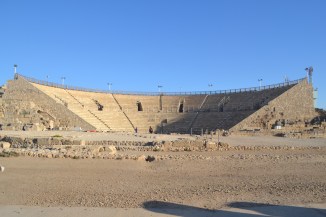
At the far end, to the south is an enormous amphitheatre which sat 4,000 people and which has been restored and is used today.

image

The Med. looked very inviting, but we resisted a dip. However we could not resist some excellent Italian ice cream, even though our shekels were rapidly decreasing. Israel was always an expensive country but thanks to Boris Johnson and his lying bunch of Brexitiers, it is even more so now. I hope all those who voted ‘yes’ will be happy to pay more for everything when they go abroad for their holidays. Oh, of course, they don’t like abroad do they, or anyone from it. They’ll be quite happy to stay in little England won’t they, building sea defences to repeal the next invasion.

Sorry, got carried away there for a moment. Caeserea also boasts a fine Roman aqueduct which looked beautiful in the rays of the setting sun.

Then we headed east to Galilee….or rather we didn’t. We wanted to get on the 65 road, but somehow missed it, heading further north before turning east. Night fell and road signs and the map became more difficult to read. We pressed on, passing through the centre of Nazareth…..not the loveliest of towns, and eventually into Tiberius. Once we had found the lake shore, it was a lot easier, but we still managed to miss Kinneret, the small village in which we are staying. The owner phoned us and gave us helpful directions and we arrived about 7.00 p.m.. I was utterly exhausted, so we visited the local shop and made our own meal in our rather pleasant cabin. Now, all I need is some kip to restore my equilibrium.

image

I think we might leave Nazareth for a day or so, but I suppose we will have to go there. There is plenty to see around Galilee.

Day 4 The Mount of Olives

It had to be done. Well I suppose it did. Can a Christian come to Jerusalem without viewing Christ’s supposed tomb? I think not. But neither it seems can most other religions, agnostics, atheists etc. which is why you have to get up early. 6.30 in our case and arriving at The Church of the Holy Sepulchre at about 7.30. Dani and Mike had gone to a 6.30 mass and it was pure luck that we joined the queue to get to the tomb directly behind them. The queue was not moving. We stood an chatted. Still no movement. At about 7.45 some thing seemed to be going on up ahead and sure enough the queue moved. Slowly we inched forward until at about 8.20 we got to view the marble slab on which he supposedly lay in the tomb. From there it is but a short walk and a short queue to view the supposed limestone mound which was Golgotha. Of course it didn’t have to be that high as being on a cross made you all to visible ‘pour encourage les autres’. There is a gilded hole above the stone which I assumed was to put your arm in to feel the stone. I was somewhat surprised to find it full of litter. Then it dawned on me that these were bank notes. How better to commemorate the death of our Saviour than in dollar bills or shekels?


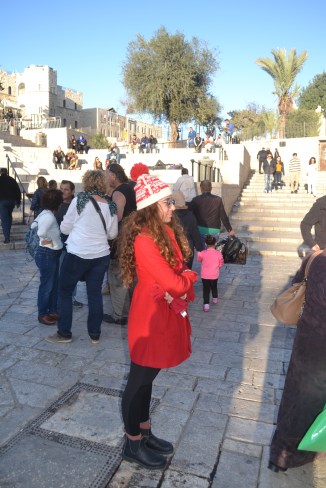
We did not linger and headed back through empty streets to our hotel and breakfast. At the Damascus Gate Christine noticed a woman n a red coat and bobble hat standing absolutely still in front of it. Christine had noticed that she had been there at 7.15 when we had passed through. Very odd.

We met Dani and Mike for breakfast and then set off to the. Mount of Olives. We headed back to the Damascus Gate. I was now 10.00 but the girl was still in the same pplace. I asked her what she was doing and apparently it was some form of independent film project. Her cameraman was on the steps to her left.

We walked down the Via Dolorosa looking for Lion Gate and St Anne’s Church. I mistook one of s number of arches for the fate and then got us completely lost. Eventually we found St Anne ‘s and it was heaving! The church is Romanesque and beautiful in its simplicity. It has a remarkable acoustic and an American Choir was trying it out with Amazing Grace. If sound quite impressive, in spite of their pronounciation. Once they had left we had the church to ourselves so I gave a quick solo of ‘Lord we beseech you.’, and yes the acoustic is quite remarkable:even  my voice sounded passable!


It is hard to work out what is what outside the church so many generations gave built over and around the pools. Add to this the vast numbers of awed Americans and clamorous Chinese and the whole experience becomes hard to enjoy. However they do stay with their leaders, few wander from the throng, so we found a walkway around the other side of the site and enjoyed some relative peace. The pools, north and south, I was particularly keen to see having written about them in both of my religious monologues, Febronia and Mary, particularly the latter. I was not disappointed. With the help of a simple guide and some plaques we managed to piece together what would have been there in the time of Christ. I imagined Mary in one of the rather posh rooms situated between the pools, favouring the northern one where the water was cleaner and the common people did not enter.

Outside the Lion Gate we entered a Moslem cemetery which gave us good views across the Kidron Valley towards the massive Jewish cemetery on the Mount of Olives. We crossed the Kidron or Valley of Jehoshaphat, dodging the multitude of tourist buses and taxis and eschewing the Basilica of the Agony, we found a quiet road up the edge of the Jewish cemetery to a viewpoint at the top of the Mount. The sun was beating down and it was quite a climb, but well worth it. As we passed the Jewish cemetery I pointed out the stones piled on many of the graves. “Why do they do that?” Christine asked. I reminded her that at our Family Remembrance Service only a couple of weeks ago I had based the service on this Jewish ritual and we had all laid stones around the font. It clearly had made quite an impact!


We treated ourselves to a cereal bar as we looked across to the walled city and then after using the impeccable toilets we headed further up to the Mosque of the Ascension. Within its grounds is a beautiful little chapel dating from about 1200. Inside is a piece of stone with a supposed footprint our Lord left behind as a left for heaven. If so, he had surprisingly large feet.


We descended via a much busier road and enjoyed an overpriced, but delicious pomegranate juice at a small cafe at the bottom. Back through the Lion Gate we navigated our way across the old city to the Jaffa Gate. The Via Dolorosa was blocked in places by thrombosises of tourists, clustered around their guides, drinking in every word and quite oblivious of everyone else. Eventually we struck off away from the crowds, but met them again as we approached the Jaffa Gate.


Our aim was to walk on the walls which run between Jaffa Gate and Dung Gate. It cost 18 shekels each, but I produced my senior railcard and got in for 8 as a senior citizen! The walk was lovely but hard work. Every tower had massive stone steps up and down and by now our legs were feeling like jelly. At Dung Gate we set off in pursuit of refreshment, but decided instead to buy some cakes and head back to the hotel for afternoon tea on our terrace. We bought some delicious cakes from a stall near the Damascus Gate and as we passed through there was the girl, standing in the same spot. Christine asked if she had had a break and was released to hear that she had. She was still being filmed, so I presume we are now part of an art installation to be screened in the future!

image

Tomorrow we leave Jerusalem for the Sea of Galilee and hopefully a less frenetic and cheaper few days.

Day 3a – Christian Jerusalem

We asked the driver to drop us off at the Jaffa Gate and, after a couple of reasonably cheap coffees and some extortionate biscuits, we went into the Citadel. As some small recompense of the devastating attacks on my wallet sustained so far I was given a 5 shekel reduction on the entry fee. This in spite of not really qualifying as you have to be 67 to be an OAP in Israel! The citadel was just what we needed. It was quiet, beautiful and had a very interesting display of Jerusalem’s history. Much of the Citadel’s structure dates from the Middle Ages, but it’s foundations are much older.

We climbed Phasael’s Tower and were presented with stunning views over the city. We walked along the ramparts and entered the various exhibition rooms which gave a superb history of the city. We wandered around the archaeological remains in the gardens at the centre of the structure. It was delightful and an hour and a half passed very quickly.


I had noticed some people on the city walls, so we made an attempt to join them, but unfortunately, like the Citadel, they closed early on a Friday in preparation for the sabbath. Instead we walked into the Armenian quarter and found St James’ Cathedral which is only open for half an hour each day. By luck we were there on time. It is magnificent. I have never seen so many censers in one room in my life! A small group were being shown around and were being harangued by one of the priests about the tiles. Apparently a guidebook had wrongly ascribed them to the Turks in the 12th century. Outrageous! They are clearly 18th century and Armenian! As he became distracted the group slipped away, but we were not quick enough. The harangue continued with documents brought out to prove his point. Desperately trying to dodge his halitosis I found myself cornered and forced to photograph, both the offending page in the guidebook and his letter to the publisher. Finally we were allowed back into the main church as the service was beginning. We melted into the shadows at the back and listened to the mist beautiful intoning of the Bible followed by exquisite monkly singing. A deep sense of peace descended….a little piece of spiritual healing…….a blessing perhaps.


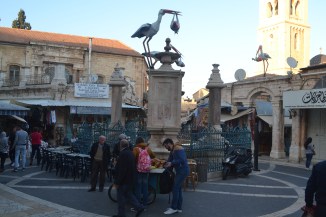
Then it was down to the Dung Gate, the Zion Gate and back into the Christian quarter, looking for St Mark’s Church and the ‘upper room’. Unfortunately it was closed so we headed for the Muristan, which is a square with alleys radiating off of it , lined with shops. There is a fountain in the centre and some rather strange ‘statues’ of storks with fish in their bills.image No idea what that was all about. The Greek Orthodox Church of John the Baptist backs on to this but the entrance is hard to find. Eventually we circumnavigated it via the souk and found a narrow door between shops that led into a beautiful courtyard. From there we entered the church, one of the oldest churches in Jerusalem. It us being repainted, but is still very attractive with a massive iconostasis. The white walls are being painted with scenes from the bible in bright colours.


Back into through the Muristan, we visited the Lutheran Church , but decided against going in as it is quite modern and wanted to charge us quite a bit to enter. Instead the Russians got our money. The Alexande Hospice is Russian Orthodox and built over some impressive ruins. In the basement is the remains of a threshold of a city gate, believed to date from the time of Herod the Great. It is likely that this was the Judgement Gate through which criminals passed on the way to Calvary to be crucified. Could Jesus gave passed over this stone? Alongside it is a piece of wall through which is an opening just big enough to allow a person to pass through. When the gates were shut at night, late comers could pass through this, but horses and camels couldn’t. It is shaped like the eye of a needle! This makes so much sense as an explanation of Jesus’s comment about it being harder for a rich man to enter heaven than for a camel to  pass through an eye of a needle!


We returned to saunter down the souk, marvelling at the brightly coloured sweets and the hunks of meat hanging in the butchers.


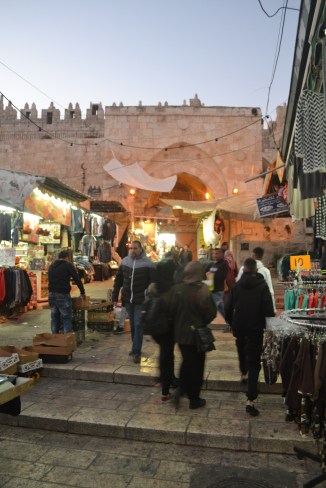
We arrived at the Damascus Gate as it was tinged with pink by the setting sun and looked quite beautiful. Jerusalem is quite some city. The old part is fascinating, quaint, and interesting. The modern part is busy, clean and has excellent public transport. I love it!

image


Day 3 – a morning in Bethlehem


Another early rise, but not quite so early, thank goodness. Mini-bus to Bethlehem and our first close-up sight of the wall. Horrible. We also passed  Baksy’s ‘Walledoff Hotel’ and managed to convince the driver to stop there briefly on the way back.


Our guide, Ashraf, a Palestinian Christian, met us inside the wall and took us to Star Street, the old road into Bethlehem from the north. It follows the old cliff line and was likely to be the route Mary and Joseph took into the village. It had been lined with souvenir shops, but the conflict has meant that many Palestinian Christians have left the town and mosr of these shops have closed. We walked into Manger Square where preparations were underway for the advent celebration tomorrow.


Then into the Church of the Nativity, a heavily ornate Greek Orthodox Church with an imposing iconostasis. We queued behind an excited group of children to go down to the nativity site under the main altar. It is quite a small room but we managed to touch the stone where Mary supposedly gave birth and to see the place where the manger ma have been. I hoped I might have felt something, but I’m afraid not. Perhaps I am too much of a cynic? Anyway the church was impressive although much of it was swathed in plastic as it was being restored. There were some beautiful mosaics from the 4th century and a charming courtyard and cloister.

From there we were led like sheep to a Palestinian Christian souvenir shop. Everything was made locally we were told, but they were expensive and even with a discount we felt ripped off. We walked in to the Milk Grotto where apparently Mary and Joseph stopped on their way to Egypt and Mary fed the infant Jesus. Spilling a drop of milk turned the cave white. Hmmmmm. What was touching was to watch a young child move behind our group to the picture of Mary feeding her infant, kneel before it, touch it and pray. Such faith, puts mine to shame. I’m afraid the sight of ‘baby Jesus’ surrounded by dollar bills seemed to me a more eloquent testimony of what modern day Bethlehem is all about.

We walked down a hill which afforded fine views over the east of the city and a nearby town built on the shepherd’s field in recent years. Room in Bethlehem is still at a premium it seems!

image

The mini-bus took us back to Jerusalem, but we had to wait for over 20 minutes to get out of the Palestinian sector, an indication of what Palestinians have to go through every day if they work outside the wall.

To sum up, for us, Bethlehem was a disappointing experience, but for Dani and Mike it was everything they hoped for which was wonderful. The afternoon proved much more interesting for us in the end………..


Day 2 – Masada, Ein Gedi and the Dead Sea

Another wonderful day with the odd surreal moment. We rose early (5.10 to be precise!) and walked to the tram stop. I took control of the ticket machine while everyone else told me what to do! Somehow we purchased 4 tickets. 3 stops on we alighted and Christine found the hostel from which the trip started.

Let me say from the start that if you ever go to Jerusalem take an Abraham’s Tour ( strap line: ‘exploring for 3,000 years’), they are just brilliant. We were by far the oldest on the mini-bus, but the guide was informative and delightful. The bus was comfortable and very modern. We drove out through the Negev Desert to the Dead Sea, which is rapidly shrinking as the Israelis extract more and more water from the Jordan. We arrived at Masada at about 8.40, but still weren’t the first to the top. The cable car was spectacular and mercifully short. A herd of women from Baltimore came in behind us in the car and it was like being enclosed in a tin can with a load of hornets. The noise was incredible, and all in that guttural whine of the east coast. We fled into the commander’s house, while they sat to listen to their guide tell them what they were going to see. But we were not safe for long and they pursued us around the site until we eventually out ran them as we made our way through the 29 enormous storehouses which kept the Herodan settlement fed. imageWater had to be carried up from below and emptied into enormous cisterns, which could also be fed on the odd occasion it rained (on average 3 days a year apparently). It was while admiring one of these cisterns that we stumbled over a collection of American Jewish school children. Thus was almost worse than the ladies, but luckily they were called into a circle by their teacher who proceeds to lead them in some callisthenics. That should wear the little buggers out, we thought. We moved rapidly along the west wall, admiring the stunning views to the southern tip, where peace reigned and the views were fantastic. We walked back along the east wall, taking pictures of the Dead Sea, now bathed in a sharp morning light. The story of Masada is both tragic and heroic and has made me want to come here from an early age. If you don’t know it, do google it.

Back down below, we drove to Ein Gedi Nature Reserve, a spectacular green cleft in the rock wall of the desert and a haven for wildlife. We passed ibex grazing near the road. Then we walked up into the valley, passing a number of waterfalls and a family of rock hyraxes sunbathing on a rock.

Butterflies and birds danced before our eyes. It was beautiful.

David’s waterfall is the highest one you can walk to, but as we turned back I spotted a track which led higher up the mountain and with Christine’s permission, set off up it, quickly followed by 2 Dutchmen from our tour and another young man of indeterminate nationality. We moved upwards at speed and in places the going was tricky, but the resulting views at the top over the Dead Sea were spectacular. The other young man then suggested that we should set off back down if we were to get back to the bus on time. I was for pressing on, but his common sense prevailed and we yomped back down. I was flattered by one of the young Dutchmen asking his old I was and looking rather surprised when I told him!

image

Then we headed for a private resort on the Dead Sea for a bathe. The mini-bus radio was on and suddenly ‘the jingle bell rock’ came on. A surreal moment , driving through the Negev Desert in temperatures above 30C singing along to a Christmas song! At the resort, the four of us made a camp on the beach (sea of mud and salt) and took it in turns to bathe. It is weird, lying, floating and reading a newspaper. Hard to get back on to your feet afterwards unless you roll over onto your knees. It was great fun and Dani went for a mud covering as well as it is supposed to be great for the skin.

We arrived back in Jerusalem at 4.00, tired and happy. I think we are getting to like Israel a lot. But my goodness it is expensive! We shall dine here tonight as last night’s meal was delicious and it is relatively cheap! Tomorrow Bethlehem, so we are going to be little stars!

Jerusalem – Day 1

We rose rather late, after our late arrival last night and sauntered down for a leaisurely breakfast in the bowels of the hotel. Dani and Mike joined us after about 20 minutes and we enjoyed cheese, olives, bread, jam , cornflakes etc. and some lively chat. Christine and I decided to visit the Moslem and Jewish quarters today as buildings in these areas would be less likely to be open on Saturday or Friday afternoon, our other two opportunities to visit.

However our first stop was the ‘Garden Tomb’, possibly the tomb Christ was laid in, but possibly not! Certainly one got an idea of what such a tomb would be like and it was very pleasantly set out with some interesting trees and shrubs. A group of Nigerian Christians bought an unexpected burst of colour to the scene. image

We then entered the old city through the Damascus Gate and after passing an array of vegetable stalls turned left into the Via Dolorosa. However we were momentarily waylaid by the sight of a pomegranate press and a man operating it to produce the most wonderful juice. Memories of Damascus flooded back as we tasted it’s sweet, sharp deliciousness! The wonderful cry of the muezzin filled the street as we headed for the Monastery of the Flagellation. This is Franciscan and is said to be the place where Christ was beaten. A beautiful courtyard and a lovely church greeted us, although Christine got told off for bringing her pomegranate juice in with her. Naughty Christine!

Back down the Via Dolorosa, I decided to try a back alley to see where it led, but we got turned back by armed police as it led to the mosque and so was for Moslems only. Naughty Richard!

So, instead, we entered a Greek Orthodox church to view the prison in which the two thieves and Barabas were supposedly kept. I think I’d have given up all hope if I’d been put in there! Next door was Jesus’s prison and, again, it was pretty grim.

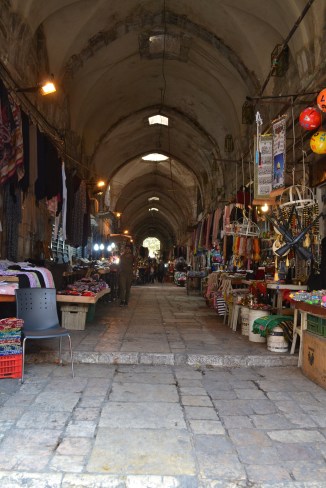
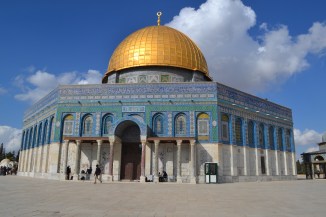
Back in the Via Dolorosa we kept on down El Wad and into the souk, full wonderful smells and colours. imageWe then got a bit lost and found ourselves trying to get into the Temple Mount again. This time a pleasant policeman explained that it was only open to tourists from the Western Wall side between 12.30 and 1.30. So we headed for the Western Wall. It was quite a sight and I think the first time I felt moved today. It wasn’t particularly busy and we both went down to the wall to touch it and to pray – Christine on her side and me on mine. Then we joined the queue to get into the Haram esh-Sharif or Temple Mount.we queued for about 20 minutes or so and eventually went through security just before 1.00 p.m.. We climbed up a steep walkway and on to the mount, and there before us was the Dome of the Rock. It is amazingly beautiful and set in very pleasant grounds with good views over the Mount of Olives. We wandered around it , but we’re not allowed in – Moslems only unfortunately. The same was true of the El Aqsa mosque, but there it is. We spent a very pleasant 40 minutes strolling around before some quite officious security people told us to leave. image
By now we were hungry and found a delightful place to eat in the souk. According to the owner it had been there for 1,500 years and certainly it looked like it, but it was clean and the food was excellent – a dish of taboulleh and another of Baba Ganoush, washed down with mint tea – delicious!

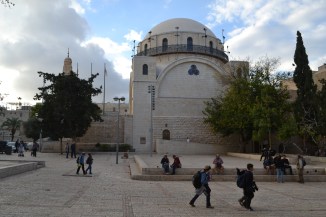
Fortified we headed up a steep set of steps and into another souk – in fact three of them which run parallel into the Jewish quarter. We stopped at the Hurva Synagogue and went in. Hurva means ‘ruin’ in Hebrew and this synagogue had been rebuilt on the site of two others destroyed at various times. We took an audio guide around it and watched the scholars arguing over scripture in the synagogue before climbing up onto a balcony that gave panoramic views of the city. I had a distinct feeling of vertigo at the top, but managed to overcome it and circumnavigate the dome albeit holding on to the railings for dear life!image

Back on the ground we visited the Cardo, the Roman street that ran through the heart of the city – hence the name, (we learnt from a passing guide). We meandered through much restored streets , where clearly a great deal of money had been spent on the buildings. This was a wealthier area than the Moslem quarter. We descended into the foundations of a modern building to view the remains of the old city walls and the climb back up convinced us we had done enough for the day. We stopped on the way back to look at an Armenian church where it was said Jesus met his mother on the way to Calvary. His footprints are apparently preserved in a mosaic floor!

An outrageously expensive coffee and baklava set us up for the final short walk to the Damascus Gate and our hotel. The moon has come up over the city and the place looks beautiful. A great first day, but an early rise tomorrow as we head for the Dead Sea and Masada. Tonight the four of us will exchange travellers’ tales over dinner and solve the Middle East crisis …..or maybe not…..depends on the number of beers we can afford really.